Speed of Light
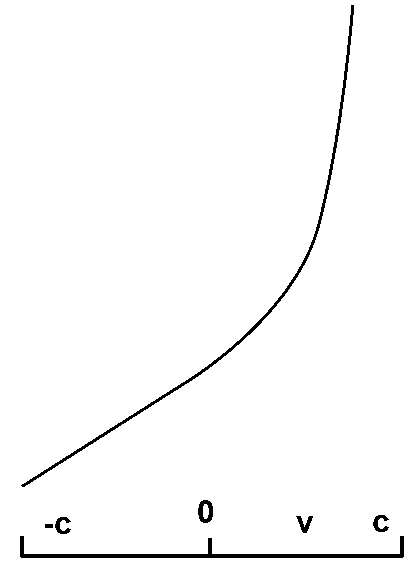
A light beam is to traverse a segment of length l. This segment is assumed to lie along the same straight line as the light beam. The segment may be moving along its own direction at a velocity v. How long does it take for the light to cross this segment?
In the case of a stationary segment , v = 0, the time required is, naturally, t0 = t = l/c, where c is the speed of light.
With a positive velocity, the segment will have advanced by a distance of v·t0 after time t0 has elapsed.
The light must still cover this additional distance of v·t0.
The subsequent time required to cover this gap would be (v·t0)/c, The elapsed time thus becomes t = (l/c)·(1+v/c).
This, in turn, creates a new deficit. A geometric series emerges: (l/c)·(1 + v/c + (v/c)² ...).
Summing this series yields t = (l/c)/(1-v/c), featuring a singularity at v = c.
With a negative velocity, the light has already overtaken the segment after time t0 = l/c.
The excess distance is once again (|v|·t0)/c. Now, it has to be subtracted.
The total time required is therefore t = (l/c)·(1 + v/c) or (l/c)·(1 - |v|/c), and this value remains final.
The overall function:
This function is discontinuous (at 0) in its second derivative and has a singularity at c.
Ludwig Resch