Connection in the Snow Globe Theory
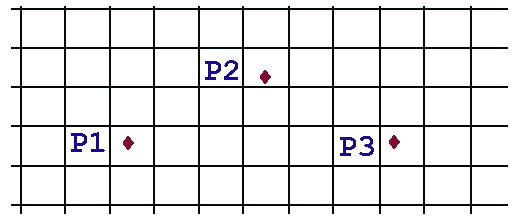
This image is intended to represent a set of points in two-dimensional space.
It lacks the third spatial dimension and time, which are required for physical reality;
it is merely a moment. Although the Euclidean spatial grid applies to every point, it does not employ the same scales for all points.
Thus, a "meter" at one such point is larger or smaller than a "meter" at another point.
However, according to the snow globe law, a meter measured locally remains simply a meter.
If a meter (possessing rest mass) is moved from one point to another, its local length does not change,
even though it becomes larger or smaller. No change is perceptible during transit, either. Only light, which lacks rest mass, shows a color change.
The Euclidean space, which utilizes a different scale relative to other points,
functions like a tangent space defined as disjoint from other tangent spaces.
Because of theorem S2 of the snow globe theory, the reciprocal of the scale change allows one to calculate the physical behavior of another point.
S2 thus establishes a connection between different locations.
If multiply differentiable curves pass through a point,
then even a straight line possesses a second derivative due to the varying scales.
This yields a metric. Within this metric, one must use the reciprocals of the scale changes,
as calculations rely on data from neighboring points. According to Gauss's "Theorema Egregium",
this metric allows for the construction of a space with curved spacetime.
Note: Values based on different linear scales can coincide at, at most, one point.
Ludwig Resch