A Curved Spacetime is an Observer Ether
"If we were to speak of the ether today, we would have to grant each frame of reference its own particular ether..." (Arnold Sommerfeld)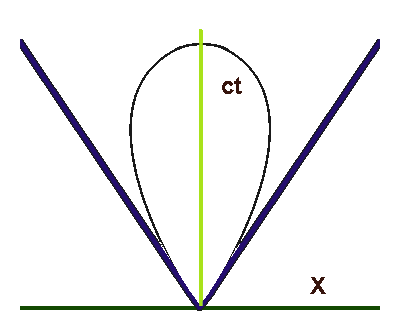
This Minkowski diagram contains a curve of proper times relative to the stationary system (A). Thus, if 10 seconds have passed in system A, system B has one second of proper time. What proper time has system A "seen"* from system B? Answer: 1/10 of a second. How is this possible? Every straight line through the origin represents a constant velocity. Although all objects have met at the origin, in each system, only a portion of the other systems can be registered, as time dilation with proper time allows. It is therefore self-evident that the world appears different from every point.
Cosmologically, a model would be the " "sinc sphere".
Imagine the surface of a four-dimensional sphere. From the starting point to the opposite point on the sphere,
space is supposed to continuously contract to zero,
which is what the sinc function achieves. The opposite point is infinity.
The actual distance is given by the integral of the inverse of the function.
However, if one takes a different starting point, all relative scales change.
Scale changes are therefore dependent on the point of view.
Likewise, a real space with internal curvature must also be dependent on the point of observation everywhere in the world.
Einstein's general relativity is thus a special approximation from the starting point at the maximum length scale of a central star.
This also applies to energies, similar to kinetic energy in special relativity, and also to masses according to Einstein's formula.
*This cannot be seen optically, only measured. Otherwise, one would have to factor out the properties of light.
Ludwig Resch